
Digital Marketing Statistics 2026: Key Data, Trends & Growth Insights
- The Importance of Data-Driven Marketing in 2026
- AI, Automation, and Analytics in Digital Marketing
- SEO and Organic Search Statistics
- Content Marketing Statistics
- Social Media Marketing Statistics
- Paid Advertising and PPC Statistics
- Email Marketing and Automation Statistics
- Video Marketing Statistics
- Conclusion
- The Importance of Data-Driven Marketing in 2026
- AI, Automation, and Analytics in Digital Marketing
- SEO and Organic Search Statistics
- Content Marketing Statistics
- Social Media Marketing Statistics
- Paid Advertising and PPC Statistics
- Email Marketing and Automation Statistics
- Video Marketing Statistics
- Conclusion
In the year 2026, the digital industry is experiencing a complete transformation. Success now requires business owners and marketing teams to shift their focus towards data-driven precision to effectively navigate a saturated, AI-driven market. Relying on last year’s tactics is no longer an option; real-time metrics are now your primary tool for ensuring ROI.
According to the reports from HubSpot’s 2026 State of Marketing, 68.8% of marketers feel confident keeping up with new social media features, yet the challenge lies in effectively leveraging that data. Furthermore, Statista reports that over 67.9% of the global population is now online, creating a digital space that is more lucrative yet more competitive than ever.
In this guide, we break down the critical benchmarks you need to scale. We will dive into the latest insights across SEO, content marketing, social media marketing, paid advertising, email marketing, and so much more. Whether you are optimizing for AI-driven search or refining your video strategythese statistics provide the roadmap your team needs to dominate.
In a Nutshell
In 2026, digital marketing success relies on data-driven precision and AI integration. Marketers must leverage real-time metrics, predictive analytics, and short-form video to engage audiences. With social media becoming a primary search tool and AI reshaping SEO, teams need adaptable, intent-based strategies to ensure sustainable growth and high ROI.
The Importance of Data-Driven Marketing in 2026
The era of marketing based on intuition has come to an end as we enter 2026. Success is now defined by measurable precision, with 66% of marketers utilizing AI tools daily to steer strategic decisions. These marketers utilize AI tools daily to make strategic decisions. This shift is not just about efficiency; AI-optimized campaigns deliver higher ROI than traditional methods by replacing legacy assumptions with quantifiable reasoning.
As consumers fragment across 10+ digital channels, marketing teams must rigorously track performance metrics to maintain a unified view. The financial impact of this integration is stark: companies with strong omnichannel strategies achieve an 89% customer retention rate, compared to just 33% for those with weak channel alignment.
Projections indicate that by 2025, at least 95% of data-driven decisions will undergo automation, rendering growth entirely reliant on measurable insights. Teams must use real-time analytics to justify their spending and generate predictable revenue to achieve success. Success is now determined by numbers, not by chance.
Is your marketing strategy truly optimized for AI, automation, and modern buyer behavior?
Let's talkLoading...
AI, Automation, and Analytics in Digital Marketing
Towards the end of 2025, Artificial Intelligence has moved from a “nice to have” experiment to the backbone of high-performing marketing teams. With the data, it's clear that those themes that ignore the synergy between AI and human creativity aren't just falling behind; they are actively losing revenue.
1. Adoption of AI and Generative Tools
AI is now considered not just a tool for simplifying tasks but also a standard team member in most digital departments. As per Salesforce’s Marketing statistics, 63% of marketers are actively using AI to enhance efficiency and personalization. This adoption is about keeping up with a fast-paced market, not just novelty.
2. The Emergence of Predictive Analysis
While generative AI focuses on content creation, predictive analytics has an important effect on determining strategic decisions. Markets are now seeking the assistance of “intelligence agents” to forecast customer behavior. HubSpot’s 2025 State of Marketing Report reveals that 30% of marketers are now using AI specifically for data analysis and insights. This allows them to anticipate the needs of customers before they even raise
3. How Automation Helped In Improving ROI
Automating drives ROI by slashing manual costs and boosting productivity. Businesses average a 240% return, often recouping costs within nine months. Top performers following best practices reach a staggering 390% ROI through optimized workflows.
SEO and Organic Search Statistics
Organic search remains the backbone of digital discoverability. However, the year 2026 is characterized by the integration of Generative AI and the emergence of "Position Zero" through AI-generated overviews. To grow, teams must pivot from purely keyword-centric strategies to intent-based, AI-optimized content.
- Dominant Search Engine Share Reinforces SEO Importance
According to Statista, Google continues to dominate the global search engine market with a 90.82 percent share. However, this stronghold is beginning to show signs of erosion, with its share across all devices dipping to its lowest level in more than two decades. - Organic Search Drives a Large Share of Website Traffic
Organic search serves as the primary engine for digital visibility, consistently attracting the majority of high-intent visitors. Unlike temporary paid campaigns, it builds lasting authority and trust. By meeting users exactly when they seek solutions, organic strategies secure a reliable, sustainable flow of traffic to your website.
‣ Voice Search & AI-Powered Updates
The integration of generative AI and the maturity of voice technology have introduced the zero-click phenomenon, where users receive answers directly on the search page.
Over 20 billion visual search queries are conducted every month using Google Lens, Google’s image recognition technology, reflecting a massive increase in visual search adoption worldwide.
As per the reports of Pew Research, 2025, Google users who encounter an AI summary are less likely to click on links to other websites than users who do not see one. Users who encountered an AI summary that was clicked on from a traditional search result link in 8% of all visits. Those who had not encountered an AI summary clicked on a search result nearly twice as often (15% of visits). 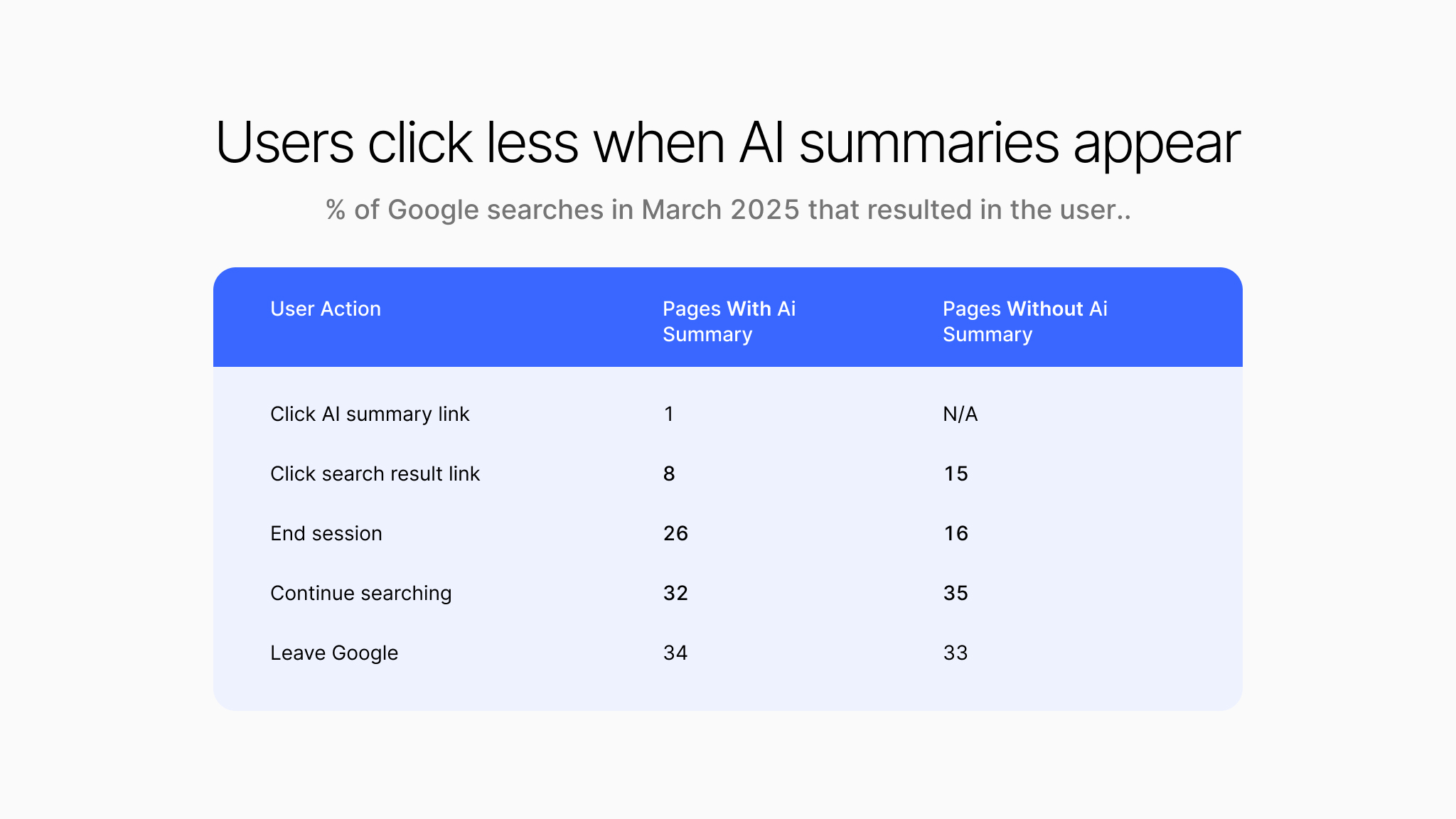
‣ Voice and Visual Search Imperative
The number of users utilizing voice search in the United States is expected to grow to 157.1 million by 2026, a 2.5 times increase from 2024.
Google Lens handles more than 20 billion search queries each month, with one in four visual searches driven by commercial intent.
Visual Search adoption for product discovery and purchasing is heavily driven by younger generations, with roughly 22% of Gen Z and younger millennials (ages 16-34) utilizing this technology. This highlights a significant shift towards camera-first shopping, outpacing 35-54 year olds and older.
‣ Leveraging Insights for Optimization and Visibility
To thrive in the search landscape of 2026, marketers must shift focus toward “Generative Engine Optimization” and multi-surface visibility.
As Gartner predicts a 25% decline in traditional volume, the “Trust Moat” built through documented expertise and verified third-party citations becomes the primary differentiator between human-led growth and AI-generated “slop.”
Organic and paid search are vital channels for tech marketers seeking to reach awareness and demand.
- Alan Antin, Vice President Analyst at Gartner.
Content Marketing Statistics
Content marketing remains the most effective way to build long-term ROI. In fact, as per the reports of HubSpot, blog posts were among the top 5 content formats marketers plan to invest most in 2026, following short-form video, live video, long-form video, and user-generated content.
1. Data on How Content Marketing Continues to Deliver ROI
Investing in content is no longer a “budget filler.” In 2026, it is considered a lead generation machine.
- The Lead Gen Advantage
According to DemandMetric, companies that maintain active blogs produce an average of 67% more leads per month than those that don’t. - A Multi-Billion Dollar Industry
Statista expects global content marketing revenue to reach $107 billion by 2026, highlighting its significance as a primary pillar of the digital economy. - Effectiveness Drivers
Research from the Content Marketing Institute for the 2025 - 2026 cycle shows that 61% of marketers have seen their content strategy's effectiveness improve, primarily due to greater reliance on content and refined team skills.
2. The Multimedia Boom: Video, Podcasts, and Interactive Content
Static text is evolving into “experiential content.” In 2026, if your content isn’t moving or talking, it's likely being ignored.
- Video Dominance
A massive 91% of businesses now use video as a primary marketing tool. According to the reports from Wyzwol, 82% of video marketers report a strong ROI for 2026, although the market is shifting toward higher quality over sheer quantity. - The 600 Million Listener Milestone
As per Edison Research reports, the global podcast listeners will reach 619.2 million in 2026, up from 584 million in 2025.
3. Role of AI-Generated Content and Personalization in Engagement
AI has moved from an “experimental tool” to “marketing infrastructure.”
- Daily Adoption
As per the reports from SurveyMonkey, by 2025, 88% of marketers had already started to incorporate AI in their daily work, and 85% plan to significantly increase that usage through 2026. - The Trust Mandate
Consumers are demanding transparency. A Gartner survey found that 78% of U.S. consumers believe explicit labeling of AI-generated content is “very important” for maintaining their trust. - Hyper Personalization
Gartner is predicting that by 2028, 60% of brands will use agentic AI to deliver autonomous, one-to-one interactions that act as “digital concierges” for buyers.
Paid Advertising and PPC Statistics
Paid advertising is undergoing a fundamental shift. In 2026, the “set it and forget it” era of PPC is officially over, replaced by autonomous AI agents and a desperate need for high-quality first-party data. To help your team navigate this high-stakes environment, we’ve synthesized the most critical performance benchmarks and projections for the year ahead.
1. Global Ad Spend Growth Projections
The global digital advertising market is entering a phase of sustained expansion as brands lean into performance-driven channels to combat economic uncertainty.
- Market Scale
Stats from Statista indicate that the worldwide advertising market will reach US$1.25 trillion in ad spending by 2026. When considering global features, the United States leads with ad spending projected at US$500.98bn in 2026. - Regional Growth
In the United States, total ad spend is forecasted to grow by 9.5% year over year in 2026. Major clinical events, such as the Winter Olympics and the FIFA World Cup, heavily support the surge.
2. Average CPC and Conversion Trends Across Platforms
Costs are rising across nearly all auction environments, but so is performance efficiency for teams using sophisticated targeting.
- Google Ads: The Anchor of Search
Google remains the leader in intent-based traffic, although CPCs have increased for roughly 87% of industries recently. - Average Conversion Rate (CVR)
The average cross-industry conversion rate has climbed to 7.52%, signaling that AI is getting better at relevant ads.
3. Meta Ads: Discovery and Social Commerce
Meta (Facebook and Instagram) has evolved into a powerhouse for discovery, with the advantage of campaigns driving significant ROI gains.
- Efficiency
Advertisers using Meta’s Advantage placements see a 4% higher click-through rate and a 3.8% lift in conversions compared to standard manual setups. - LinkedIn Ads: The High-Ticket B2B Engine
LinkedIn is the most expensive but often the most profitable for B2B social leads. - Highest ROAS
Despite high costs, LinkedIn delivers the highest ROAS for B2B SaaS at 113%, outperforming both Google and Meta in high-value lead acquisition.
4. The Shift Toward Automation and AI-Driven Bidding
AI has transitioned from an experimental add-on to the core infrastructure of modern advertising.
- Agentic AI
Two-thirds of media buyers are now focusing on “Agentic AI,” fully autonomous systems that can plan, activate, and optimize campaigns in real time. - Efficiency Gains
Companies implementing AI marketing tools report 20-30% higher campaign ROI compared to traditional manual methods. - Creative Velocity
As per the reports from Gartner, by 2026, it is predicted that 80% of advanced creative roles in marketing will evolve using generative AI to enhance or automate asset production.
Are you using the right data and channels to maximize ROI in 2026?
Reach out to usLoading...
Email Marketing and Automation Statistics
The digital marketing ecosystem undergoes a fundamental transition from broad-spectrum communication to high-fidelity, autonomous engagement cycles. In this space, email marketing has solidified its position not merely as a legacy tool, but as the central nervous system of a brand’s owned media strategy.
- Email Marketing and Automation Statistics
Email marketing continues to be the most effective digital channel, delivering an average ROI of $36 for every $1 spent. Statista projects a global user base of 4.73 billion, with daily volumes reaching 392.5 billion emails.
Growth of AI-Driven Email Automation Tools
2026 is a year characterised by widespread AI adoption for journey orchestration and content velocity
- Marketing Growth
63% of marketers have begun to utilize AI in their email marketing campaigns. As per the Email Vendor Selection reports, 71% are specifically employing ChatGPT.
Video Marketing Statistics
The world has shifted from being “video optional” to “video first,” with online video projected to account for 82.5% of all web traffic. Marketing teams must master the nuances of platform growth, consumer psychology, and format-specific ROI to stay competitive.
1. Viewership Growth: YouTube, TikTok, and OTT Revolution
The “Streaming Wars” have matured into a battle for integrated attention across social and television screens.
- YouTube’s Living Room Dominance
YouTube is now the world’s largest media platform. In a significant shift, televisions have become the primary device for watching YouTube in the U.S., with the platform capturing a 12.6% share of all viewing time. - TikTok Search Engine
According to eMarketer’s Social Search Usage and Trends 2025 report, TikTok is no longer just for entertainment; it is a primary discovery tool. 58.8% of Gen Z consumers now use TikTok for search, compared to 44% who use AI tools like ChatGPT. - YouTube Shorts Explosion
As per the reports from The Wrap, YouTube Shorts has reached a massive scale, generating over 200 billion views per day, nearly a 3x increase from early 2024. - OTT Market Maturity
The global subscription Over The Top (OTT) market is expected to surpass $165 billion in 2026, with the total number of global subscribers reaching 2.0 billion.
2. Consumer Preference: Why Video Trumps Text
The “preference gap” between video- and text-based learning has reached an all-time high as consumers seek faster, more engaging ways to learn.
- The 8.6x Preference Multiplier
When asked how they want to learn about a product, 63% of consumers prefer a short video, while only 12% opt for text-based articles. This represents an 8.6x preference gap in favor of video. - Instructional Superiority
Reports from Demandsage show that 83% of people prefer watching a video over accessing instructional or informational content via text or audio.
3. Short Form vs. Long Form: Engagement vs. Conversion
Successful teams in 2026 are using a “biomodal” strategy: short form for reach, long form for revenue.
- Short Form (The Hook)
Videos under 1 minute achieve the highest engagement rate at 50% but typically see a low 1% conversion rate. - Long Form (The Closer)
Conversion power lies in depth. Videos over 60 minutes have a lower engagement rate (17%).
4. Adapting for Maximum ROI: AI and Shoppable Video
To drive growth, brands are integrating technology directly into the viewing experience.
- The Power of Personalization
As per the data from SellersCommerce, over 55% of consumers now prefer personalized AI-generated videos over generic content.
Conclusion
Digital marketing statistics clearly show that success across channels depends on how effectively teams use data. From SEO and content performance to paid media, social engagement, and AI-driven experiences, the most impactful metrics reveal where audiences engage and what drives conversions. High-growth teams turn these insights into action by aligning content, platforms, and messaging with real user behavior.
To stay competitive, companies should use data to guide every strategic decision. Regular performance reviews, continuous testing, and experimentation across formats help teams adapt quickly to changing algorithms and audience expectations. Monitoring trends and refining strategies based on measurable outcomes ensures sustained relevance and efficiency.
Now that you clearly understand the key digital marketing statistics, it's time to put insights into action. Webandcraft helps brands turn data into high-impact strategies aligned with evolving trends. Enhance your presence with a versatile range of digital marketing specialists. Whether your goal is to dominate search through SEO, engage audiences through Social Media and Content, or drive ROI through Performance marketing, we guarantee that your campaigns consistently deliver results.
Ready to turn 2026 marketing data into real growth for your business?
Let's talkLoading...
- Ecommerce Digital Marketing in 2026: Actionable Strategies & Tips
- Digital Marketing Strategy: Building a Winning Plan for 2026
- Guide to Winning with PPC: Optimizing Your Paid Search Strategy
- Customer vs Consumer: What's the Difference?
- How to Increase Views on Instagram Reels in 2026 – Proven Viral Hacks
Discover Digital Transformation
Please feel free to share your thoughts and we can discuss it over a cup of tea.






Social Media Marketing Statistics
Social media has officially transitioned from a networking tool to the global “operating system” for discovery and commerce. As of early 2026, 69.9% of the world’s population is actively using at least one social media platform.
‣ Platform-Specific Growth: The 2026 Leaders
The top three fastest-growing social platforms all had double-digit year-over-year growth in 2025.
It has surpassed 1.59 billion monthly active users, maintaining its position as the fastest-growing platform with a 17.6% year-over-year increase.
Now exceeds 1.3 billion globally. It remains the definite B2B powerhouse, driving 80% of all B2B leads generated via social media.
It is the world’s second most visited site after Google. It is also the second most used social media platform, with active users worldwide.
In 2025, Instagram reached the milestone of 3 billion monthly active users, with 16% of these users aged between 35 and 44, contributing to a total of 78.3% of all Instagram users being under 45 years old.
‣ Engagement and Customer Behavior: Social is the New Search
The most critical shift for marketing teams in 2026 is the “Social Search” revolution. Customers are abandoning traditional engines in favor of social discovery:
Forbes points out that more than 55% of Gen Z prefer to start their product and service search through Instagram and Tiktok compared to Google search.
TikTok leads raw engagement at 3.70%, while LinkedIn, in October 2025, had the highest addressable advertising audience reach in American Samoa, at 807.5 percent.
Short-form video is no longer a trend; it is a negotiable media standard, accounting for 82% of all internet traffic.