NodeJS vs Python: Choosing the Right Backend Technology in 2026
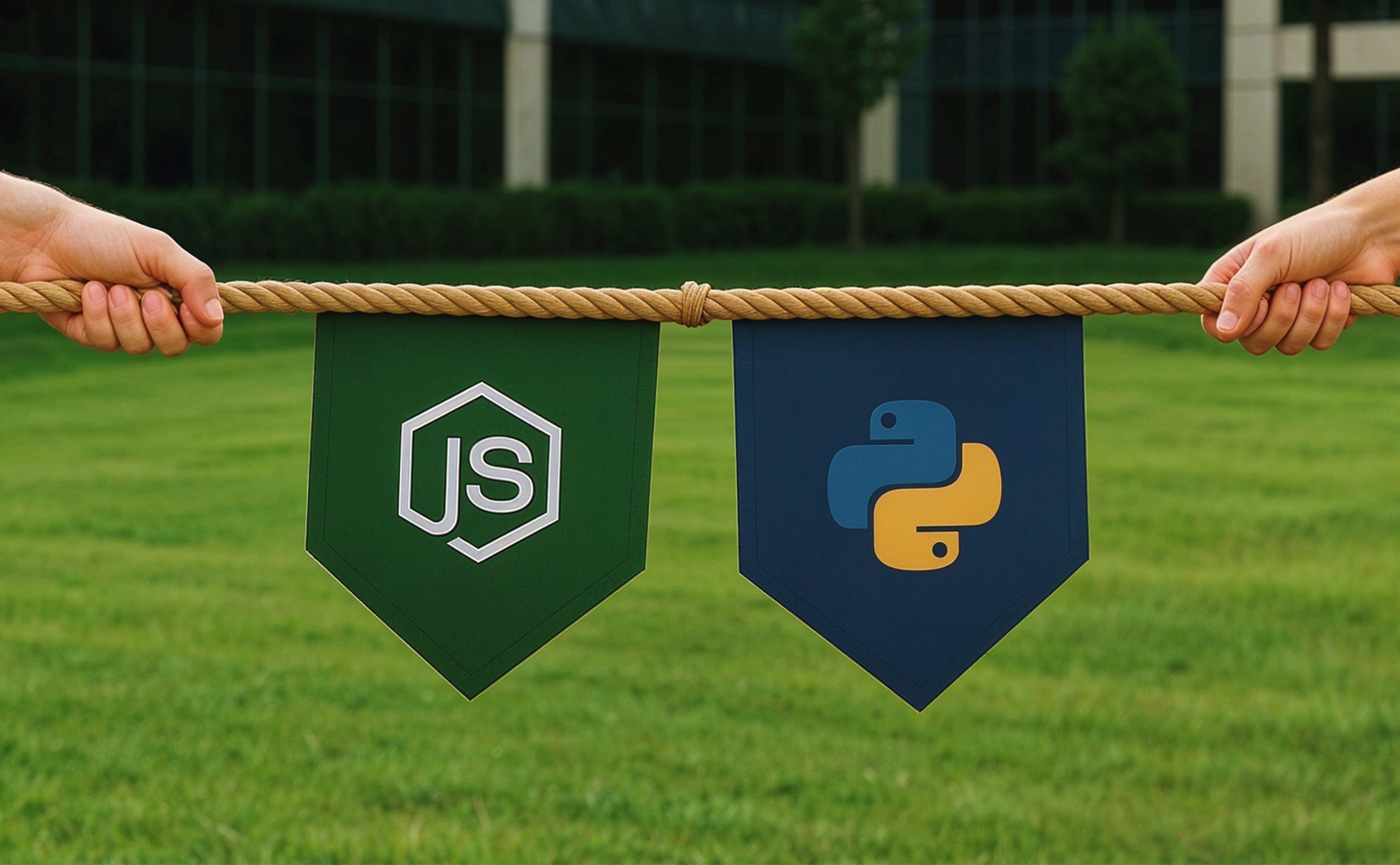
Choosing the right backend technology is one of the most defining decisions in modern application development. The choice is crucial as it determines the product’s scalability, reliability, maintenance, time-to-market, costs, and ultimately its performance in real-world business conditions. When it comes to backend web development, Node.js vs Python are the two most popular names, accounting to the multiple benefits and functionalities offered by them.
According to Statista’s 2025 analysis of the most used programming languages among developers, over 66% of developers report using JavaScript for web solutions owing to its ubiquity; meanwhile, Python continues to be a top-tier language, with 57.9% claiming to employ it in web development, majorly because of the simplicity, reliability, and dominance in AI, automation and data-driven applications.
With each backend technology possessing a range of merits, developers may find themselves at a crossroads in choosing the right tech stack. This blog cuts through the noise and provides a clear, practical comparison of Node.js vs. Python, helping you understand which one truly aligns with your product vision, business goals, and long-term scalability needs.
In a Nutshell
Choosing between Node.js and Python is crucial when building efficient and scalable backend systems. NodeJS stands out for event-driven performance, real-time capabilities, and fast execution, making it ideal for modern web apps. Python offers simplicity, robust libraries, and unparalleled support for AI, ML, and data-intensive workflows.
Node.js
Node.js is a cross-platform, open-source, server-side JavaScript runtime environment that was released in 2009 by Ryan Dahl. It is built on Google’s powerful V8 JavaScript engine and enables developers to build fast and scalable backend applications. Due to its event-driven, non-blocking I/O architecture, it can handle multiple requests simultaneously with exceptional efficiency, making it an ideal choice for data-intensive and real-time server-side and networking applications like streaming platforms, chat systems, online gaming, high-traffic APIs, and live dashboards.
Key Features of Node.js
- Easy to learn and beginner-friendly: With a vast community, extensive documentation, and tons of tutorials available, Node.js remains an accessible choice for newcomers and an efficient one for experienced developers.
- Event-Driven and Non-Blocking I/O Architecture: Its asynchronous, event-driven model enables smooth handling of thousands of concurrent connections without any performance bottlenecks. The feature makes Node.js ideal for real-world applications like gaming platforms, live streaming, and chats.
- High Performance: Powered by Google Chrome’s V8 engine, Node.js compiles JavaScript directly to machine code, enabling exceptionally quick execution and efficient server performance.
- Massive npm Ecosystem: With over 5 million packages, Node Package Manager (npm) is one of the largest open-source ecosystems, providing a massive amount of ready-to-use libraries and tools that accelerate development and minimize time-to-market.
- Cross-Platform Support: Node.js runs on Windows, macOS, and Linux. Once combined with frameworks like Electron or tools like NW.js, developers can easily build desktop apps, web apps, and even parts of mobile app backends using a single stack.
- Strong Low-Level Capabilities: It is built using C/C++, giving it ample access to system resources and powerful features like file system access, networking, and streaming data handling.
- Unified JavaScript Stack: Allows both frontend and backend development in one language (JavaScript), making development more productive and maintainable.
Python
Python is a high-level, open-source, general-purpose, object-oriented, powerful programming language, known for its versatility, simplicity, and readability. The first version was released in 1991 by Guido van Rossum, and today the programming language remains one of the most popular programming languages in the world, with 28.7k followers on GitHub. Its clean syntax and extensive libraries make it a favourite choice among beginners and experienced developers for web development, data analytics, automation, artificial intelligence, scientific computing, machine learning, and more.
Key Features of Python
- Open Source: Python is completely free, modifiable, and community-driven. It undergoes continuous refinement, releases updates, builds new tools, and offers a wealth of learning resources for beginners and professionals alike.
- Rich Package Ecosystem: Python offers thousands of modules and libraries that simplify complex application development. Whether you’re working on web development, machine learning, automation, or scientific computing, you’ll find ready-to-use packages that drastically reduce development time.
- Multi-Paradigm Support: The programming language supports multiple programming styles, including functional, structured, and object-oriented programming. This flexibility makes it suitable for a wide range of use cases, from simple scripts to large-scale enterprise systems, allowing developers to choose the coding style that best fits their project.
- Cross-Platform Compatibility: Code written with Python runs seamlessly on Windows, macOS, or Linux without major changes. This portability makes Python an excellent choice for teams working across different environments and for applications that need to reach users on multiple platforms.
- Extensible: Python integrates smoothly with other programming languages such as C, C++, Java, and even .NET, allowing developers to optimize performance-critical components using lower-level languages while leveraging Python’s simplicity for the rest of the application.
- GUI-Supported: It supports a variety of GUI frameworks, including Tkinter, PyQT, and Pygame. These libraries enable developers to build everything from simple desktop tools to complex graphical applications, broadening Python’s use beyond web and backend development.
Quick Comparison Between Node.js and Python for Web Development
| Category | Node.js | Python |
|---|---|---|
| Type | JavaScript runtime environment built on Chrome’s V8 engine | General-purpose, high-level programming language |
| Execution Model | Event-driven, non-blocking, asynchronous | Synchronous by default, native non-blocking execution via async/await |
| Performance | Optimized for I/O bound, high-concurrency workloads using a single-threaded event loop. Excellent throughput out of the box. | Competitive for async I/O. Weaker for CPU-bound concurrency due to GIL, unless using multiprocessing or native extensions. |
| Use Cases | Chat apps, streaming services, APIs, real-time dashboards, microservices | Data-heavy apps, AI/ML integration, automation tools, enterprise systems |
| Scalability | Scales efficiently via async I/O, clustering, and horizontal scaling. | Scales extremely well using multiple worker processes, task queues, and container orchestration. but may require additional tools or multiprocessing for heavy loads |
| Learning Curve | Easy for JS developers; unified frontend and backend language | Very beginner-friendly due to clean syntax |
| Ecosystem | Largest package registry by count, but quality varies widely. Strong web and tooling ecosystem. | Huge libraries for AI, ML, automation, data science; strong web frameworks |
| Frameworks | Express.js, NestJS, Fastify, Koa | Django, Flask, FastAPI, Pyramid. FastAPI competes directly with Node.js frameworks on performance. |
| Community Support | Very large JS community; fast-growing enterprise adoption | Mature community with extensive documentation |
| Speed of Development | Fast due to JavaScript reuse and vast npm modules | Fast due to readability, simple syntax, and rich batteries-included libraries |
| Real-Time Capability | Ideal for websockets and real-time features | Fully capable with async frameworks and websockets, though the model is slightly less intuitive. |
| Concurrency Handling | Single-threaded event-loop based async I/O; one primary concurrency model. | Multiple models, but requires async libraries, multiprocessing. More flexible but complex |
| Deployment | Easy deployment on JS-based stacks; works well with serverless | Universally supported across major clouds; widely used in data and enterprise apps |
| Best For | High-traffic apps, live features, I/O-heavy workloads | AI-driven apps, data-heavy platforms, automation, scientific computing, rapid prototyping |
| Overall Strength | Speed and scalability for concurrent I/O and real-time applications. | Simplicity, flexibility, dominance in data, AI, and scientific computing |
Want to power your next application with Node.js expertise?
Let's talkLoading...
An In-Depth Comparison of Node.js vs Python
1. Speed
Node.js: Node.js is built on the high-performance V8 engine and has a non-blocking event-driven architecture that excels at I/O bound operations, like handling simultaneous network or file system requests. It gives superior throughput and low latency for I/O heavy workloads compared to Python, because the JavaScript code in Node.js is JIT-compiled and event-looped.
Python: Compared to the compiled/JIT runtime like V8, Python is slower as it runs your code by interpreting it line by line. For CPU-bound tasks like heavy calculations, Python has tools (e.g., multiprocessing) to harness multiple cores.
Verdict: For I/O-bound, real-time, or high-concurrency applications, Node.js wins. Whereas, for CPU-heavy, compute-intensive jobs, Python can be competitive. But overall, Node.js is generally faster for web back-end use with its V8, which compiles code on the fly.
2. Scalability
Node.js: Due to its asynchronous, event-driven, non-blocking I/O architecture, combined with support for clustering, Node.js is specifically well-suited for scaling vertically (via scaling modules) and horizontally (adding more nodes) for high-traffic applications. Its lightweight design and efficient concurrency model enable it to handle simultaneous connections with minimal overhead.
Python: Python can scale, especially with tools like containers, multiple processes, async frameworks like asyncio, or microservices. But its built-in Global Interpreter Lock (GIL) and interpreter-based execution can make highly concurrent I/O bound scaling less efficient.
Verdict: Node.js has the edge for scalable, high-concurrency applications; Python can scale too, but often with more effort, trade-offs, careful architectures, planning, and setup.
3. Architecture
According to a community benchmark comparing the performance of Node.js and Python, it was found that Node.js processed 1800 tasks, with a concurrency limit of 200 tasks at a time, while Python processed just 300 tasks, with a concurrency limit of 20 tasks at a time.
Node.js: Node.js utilizes a single-threaded, event-driven, non-blocking I/O architecture that runs on the V8 engine. This architecture is ideal for handling multiple simultaneous connections or I/O-bound workloads with minimal resource utilization. It can simplify full-stack development and reduce context switching, since the same language (JavaScript) can work on both the client side and server side.
Python: In contrast, Python is a general-purpose, interpreted, high-level language. Its default execution is synchronous and single-threaded (because of the GIL), though one can build asynchronous or event-driven systems using libraries (e.g.,asyncio). Its architecture is more generic, making it well-suited for web services, data processing, scripting, scientific computing, automation, etc.
Verdict: The Node.js architecture appears more tailored and efficient for web servers and real-time, concurrent workloads. But when it comes to broader use cases that go beyond mere web services, Python’s generic architecture wins.
4. Extensibility
Node.js: Node.js possesses a rich NPM ecosystem, featuring myriad packages for web development, tooling, networking, etc. It also supports building native addons, though its strength is more towards web and I/O applications.
Python: Python’s highly mature ecosystem spanning web frameworks, scientific computing, data analysis, machine learning, system scripting, etc, helps with integration beyond the web. Additionally, it can interoperate with C/C++ and other languages, making it ideal for performance-critical modules or repurposing legacy code.
For Python, I felt extensibility was obviously a great thing to have…The extension modules let you do all sorts of things: communicate with graphics libraries, data flow libraries, and all sorts of file formats.
Guido van Rossum
Verdict: Overall, Python appears slightly more extensible and versatile, especially for data/science or cross-domain tasks, but Node.js is highly extensible for web/microservices work.
5. Libraries/Ecosystem
Node.js: It has NPM, a massive package repository that features web frameworks, real-time tools, and utilities. This makes developing server-side, web-based, and real-world solutions relatively easy and straightforward.
Python: Python features a more diverse and broader ecosystem, offering packages and libraries for machine learning, data science, scripting, automation, and scientific computing, besides web frameworks, making it a go-to choice beyond just backend development.
Verdict: Python dominates, for the versatility and cross-domain support offered. But Node.js remains a strong contender, especially when it comes to rapid web development or networked applications with rich web-centric tooling.
Want to turn your ideas into powerful Python-based solutions?
Let's talkLoading...
6. Security
Node.js: Even though Node.js features certain static analysis tools to detect vulnerabilities, research indicates that many vulnerabilities are not reliably detected by existing tools, highlighting the fact that the existing package ecosystem's security can be fragile if not managed carefully.
Python: A non-trivial set of publicly available packages has security issues and are seen to be susceptible to code injection, poor execution handling, etc, raising concerns, especially when using many third-party dependencies.
Verdict: Neither Node.js nor Python is inherently secure by default. Security mostly depends on the discipline of developers and teams, the use of vetted packages, security audits, and regular updates.
7. Community Support
Node.js: Node.js, with its broader JavaScript ecosystem and NPM, has a large and active community featuring many tutorials, contributors, frameworks, and community-driven modules.
Python: Python, being older and more established across multiple domains, features a massive global community, extensive documentation, abundant learning resources, and a pool of skilled developers across diverse use cases.
Verdict: It’s a tie. Both have strong, active communities. The choice should be based on the domain. If the requirement is for web or real-time work, then Node.js should be preferred. And for data, ML, scripting, or general-purpose programming, the Python community's richness is hard to beat.
8. Popularity
According to the Google Trends data, Python remains more popular compared to Node.js, with widespread use across the world.
Python: It sustains its stature as one of the most popular programming languages, especially in data science, backend, automation, scripting, and general-purpose use.
Verdict: Both are popular in their own right. While Node.js reigns supreme in web and backend domains, Python leads in broader programming contexts like ML, data science, scripting, etc.
9. Ease of Learning
Node.js: If your teams are already proficient in JavaScript, they can leverage the same language across both the frontend and backend, streamlining workflows, reducing context switching, and improving overall delivery efficiency. However, asynchronous programming involving callbacks, promises, event loop can be a bit tricky for beginners to master correctly, which can increase complexity.
Python: Python is well known for its clean, readable syntax, indentation-based structure, simplicity, and ease of debugging. This makes it very approachable for beginners and allows writing expressive, concise code quickly.
Verdict: Python is the winner, for its general ease and readability. Node.js is easy to use if you are already familiar with JavaScript, but asynchronous patterns may pose significant learning challenges.
10. Error Handling
Node.js: Traditional Node.js used a callback-based error handling, which could lead to “callback hell,” complicating error flows in nested asynchronous code. Modern Node.js, however, often uses Promises / async-await patterns, which significantly simplify error handling in async code. However, asynchronous error handling can still be complex.
Python: Python uses a classical exception-based error handling model (try/except), which many find intuitive, readable, and easy to manage. This makes debugging, writing stable code, and maintaining large codebases easier.
Verdict: Python clearly wins because it has more straightforward, easier-to-reason-about error handling.
NodeJS vs Python: Which One to Choose?
Making the choice between Node.js and Python for backend development totally depends on your performance requirements, the nature of your application, long-term scalability goals, and team expertise. Both technologies power some of the world’s most successful applications, but they excel in different areas.
Node.js is built on Google’s V8 engine and uses an event-driven, non-blocking I/O architecture. This model makes it exceptionally strong for handling highly concurrent, real-time, and I/O-intensive applications. If your product involves live chat, streaming, gaming, dashboards, or any system where thousands of users interact simultaneously, then Node.js should be your choice, as it offers superior speed and responsiveness. Its ability to handle numerous connections without creating heavy threads makes it a natural fit for scalable microservices and cloud-native backends. Another major advantage is that of full-stack JavaScript, which allows teams to use one language across frontend and backend, resulting in faster development cycles and easier code maintenance.
Python, on the other hand, is known for its clean syntax, readability, and massive ecosystem. It shines in projects that involve data processing, machine learning, automation, or complex business logic. With frameworks like Django, Flask, and FastAPI, Python enables rapid API development, strong security patterns, and maintainable architectures. Python’s dominance in AI/ML makes it ideal for applications that need recommendation systems, analytics dashboards, or predictive modeling. While Python can scale effectively using microservices, containers, and asynchronous frameworks, it generally requires more architectural planning compared to Node.js for high-concurrency workloads.
In terms of team adoption, Python is suitable for beginners due to its straightforward syntax. Node.js may require developers to understand asynchronous patterns deeply, which can be challenging, but it provides an edge when building performance-driven and interactive web systems.
Ultimately, the decision depends on your project’s core requirements. If you’re building a fast, event-driven, real-time application with millions of connections, Node.js is the better choice. On the other hand, if your application relies heavily on data manipulation, machine learning, business logic, or rapid development cycles, Python is the stronger option. Both technologies are mature, reliable, and well-supported, so the “best” choice is the one that aligns most closely with your application goals and team capabilities.
Conclusion
Summarising, Node.js should be your choice if you are looking to develop performance-intensive, real-time, and event-driven applications, whereas Python is an ideal choice for CPU-heavy, data-centric, AI-focused, and rapid development projects. The right choice depends on your project’s goals, technical requirements, and long-term scalability demands. At WAC, we bring deep expertise in both Node.js and Python to help businesses build high-performance, future-ready applications. Whether you need a fast, scalable Node.js backend or a robust, data-driven Python solution, hire Node.js developers and hire Python developers to deliver end-to-end development with clean architecture, secure code, and enterprise-grade scalability. Together, let’s transform your ideas into reliable digital experiences that grow with your business.
Still unsure whether Node.js or Python is the right fit for your project?
Reach out to usLoading...
Discover Digital Transformation
Please feel free to share your thoughts and we can discuss it over a cup of tea.